

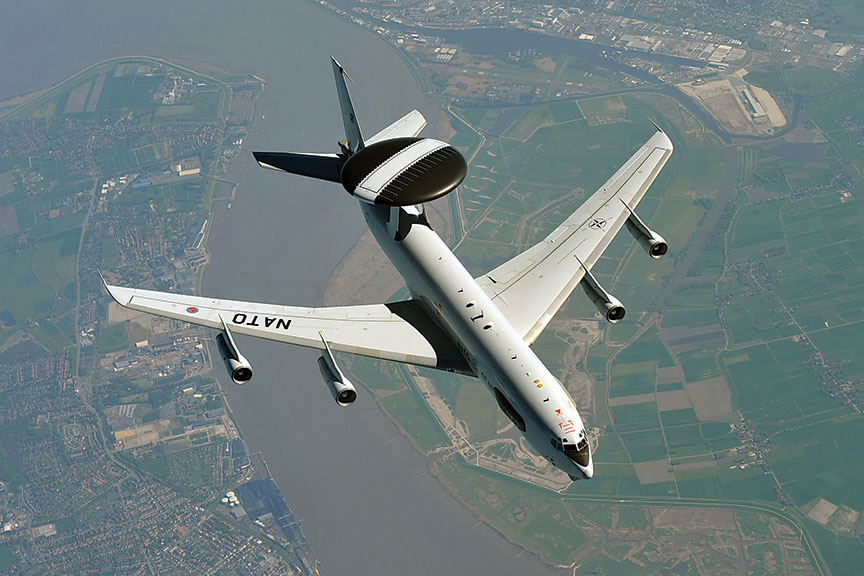

Quick intro: what is AWACS?
AWACS (Airborne Warning and Control System) is not a “fighter jet that shoots.” It’s a flying command-and-control platform designed to help other aircraft and air defenses work smarter and more coordinated.
If you imagine fighter jets as the “hands” in the sky, AWACS is more like the “eyes and brain” that helps everyone understand what’s happening and react at the right time.
What is the “circle” on top, and why is it so famous?
That circle is a radar dome (radome). The radar inside it scans wide areas to detect and track aircraft (and sometimes other contacts) from long distances. Because AWACS flies high, it often has a better line of sight than many ground radars, which can be limited by terrain and obstacles.
So the dome isn’t decoration. It’s the core reason AWACS can build a big, continuously updated picture of the airspace.
What does AWACS do that other aircraft don’t?
First, it helps with “seeing early”: finding and tracking targets across a large area, giving friendly forces more time to respond.
Second, it creates a shared picture. When every unit only sees its own small slice of information, coordination gets messy. AWACS helps unify the situation so friendly forces operate from the same understanding.
Third, it supports battle management. It can help prioritize threats and guide assets—so the operation doesn’t turn into confusion and last-second guessing.
Review: why can AWACS change outcomes?
In modern air combat, speed and missiles matter—but “who sees first and decides faster” often matters even more. AWACS shortens the gap between detection and action, reducing surprise and improving timing.
The key point: AWACS isn’t the hero by itself. The “hero” is the network it enables—better coordination, fewer mistakes, fewer duplicated efforts, and more targeted responses.
Two well-known types people usually mean
If you mean the large jet with a very clear radar disc on top, you’re probably thinking of the E-3. It’s bigger and often associated with wide-area, long-duration missions.
Another famous type is the smaller, propeller-driven E-2 family, commonly linked to aircraft carrier operations. Similar purpose, different operating environment and mission style.
Review: AWACS has weaknesses too
AWACS is a high-value asset, which also makes it an attractive target. That’s why it usually operates in safer airspace with escorts and layered protection, rather than right on the front line.
Another sensitive point is connectivity. AWACS is most effective when it can quickly share data with others. If communications or networks are disrupted, even the best radar loses part of its value.
Conclusion
AWACS isn’t just a weird “aircraft with a circle.” It’s a tool for information advantage—helping friendly forces rely less on guessing and more on real awareness. It may not be a fighter, but it can dramatically improve how fighters and defenses perform.
Next time you see that roof dome, remember: it’s a symbol of “seeing the battlefield” in modern warfare.