

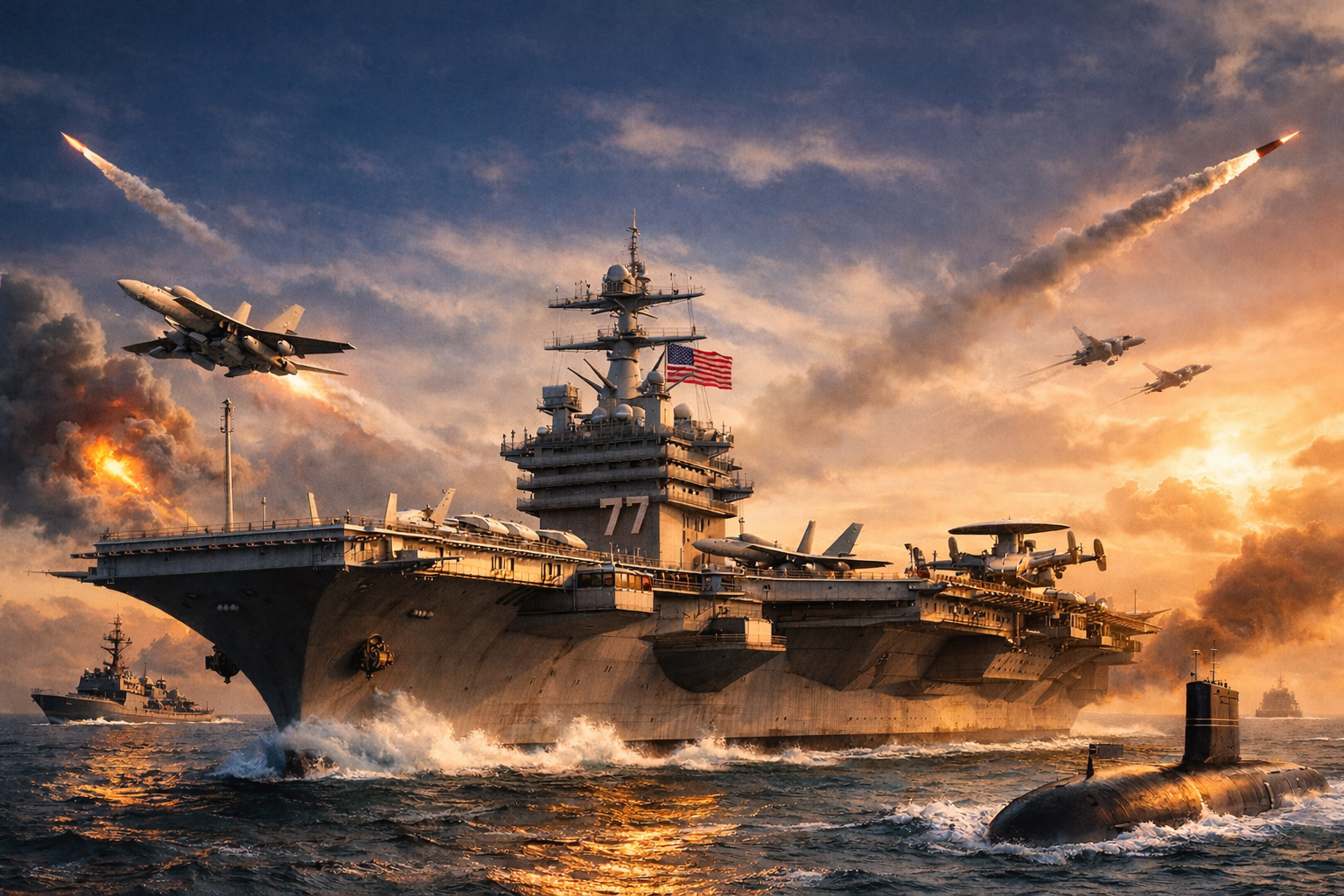

Measuring approximately 333 meters (1,092 feet) in length and displacing nearly 100,000 tons when fully loaded, USS George H.W. Bush is among the largest moving structures ever built. Powered by two nuclear reactors, the ship can operate for decades without traditional refueling, giving it unmatched endurance at sea.
With a top speed exceeding 30 knots and a total complement of roughly 5,000 personnel—including ship crew and air wing—the carrier functions as a fully operational mobile airbase. Logistically, it can remain deployed for extended periods, limited primarily by food supplies and maintenance cycles rather than fuel.
The Air Wing: The Core of Its Power
The true strength of the carrier lies on its flight deck. Its air wing typically includes F/A-18 Super Hornet strike fighters, forming the backbone of both offensive and defensive operations. Supporting them are EA-18G Growler aircraft specialized in electronic warfare, capable of disrupting enemy radar and communications networks.
E-2 Hawkeye airborne early warning aircraft provide command-and-control capabilities and wide-area surveillance, while MH-60 helicopters conduct anti-submarine and logistical missions. At peak tempo, the carrier can generate over 100 sorties per day, effectively functioning as a full-scale air force at sea.
Carrier Strike Group: A Layered Defense Network
USS George H.W. Bush does not operate alone. It typically sails as part of a Carrier Strike Group (CSG), which includes guided-missile destroyers, cruisers, a nuclear-powered submarine, and supply ships.
This layered structure provides comprehensive protection against aerial, missile, and submarine threats. Targeting the carrier would require penetrating a highly integrated and networked defense system rather than confronting a single vessel.
Strategic Role: Instrument of U.S. Foreign Policy
Aircraft carriers are not merely tools of war; they are instruments of strategic diplomacy. The deployment of USS George H.W. Bush to a crisis region signals both military readiness and political resolve.
In many cases, the mere presence of such a carrier has served as a deterrent, influencing regional calculations without direct combat engagement. Its ability to operate independently of host-nation bases provides Washington with flexibility and rapid-response capability in volatile environments.
Vulnerabilities: Is the Supercarrier Invincible?
Despite its formidable defenses, the carrier is not invulnerable. The development of anti-ship ballistic missiles, long-range precision strike systems, advanced submarines, and saturation drone attacks has introduced new strategic challenges.
The U.S. Navy mitigates these risks through layered missile defense systems, electronic warfare superiority, intelligence dominance, and distributed fleet operations. Nevertheless, any serious damage to such a high-value asset would carry profound military and political consequences.
Presence in Strategic Waters: Signal or Preparation?
When USS George H.W. Bush enters regions such as the Persian Gulf, it does not automatically indicate imminent conflict. More often, it represents deterrence and strategic signaling.
However, the carrier’s operational readiness means it can transition rapidly from a posture of presence to active combat operations if required. This blend of preparedness and restraint defines its enduring strategic relevance.