

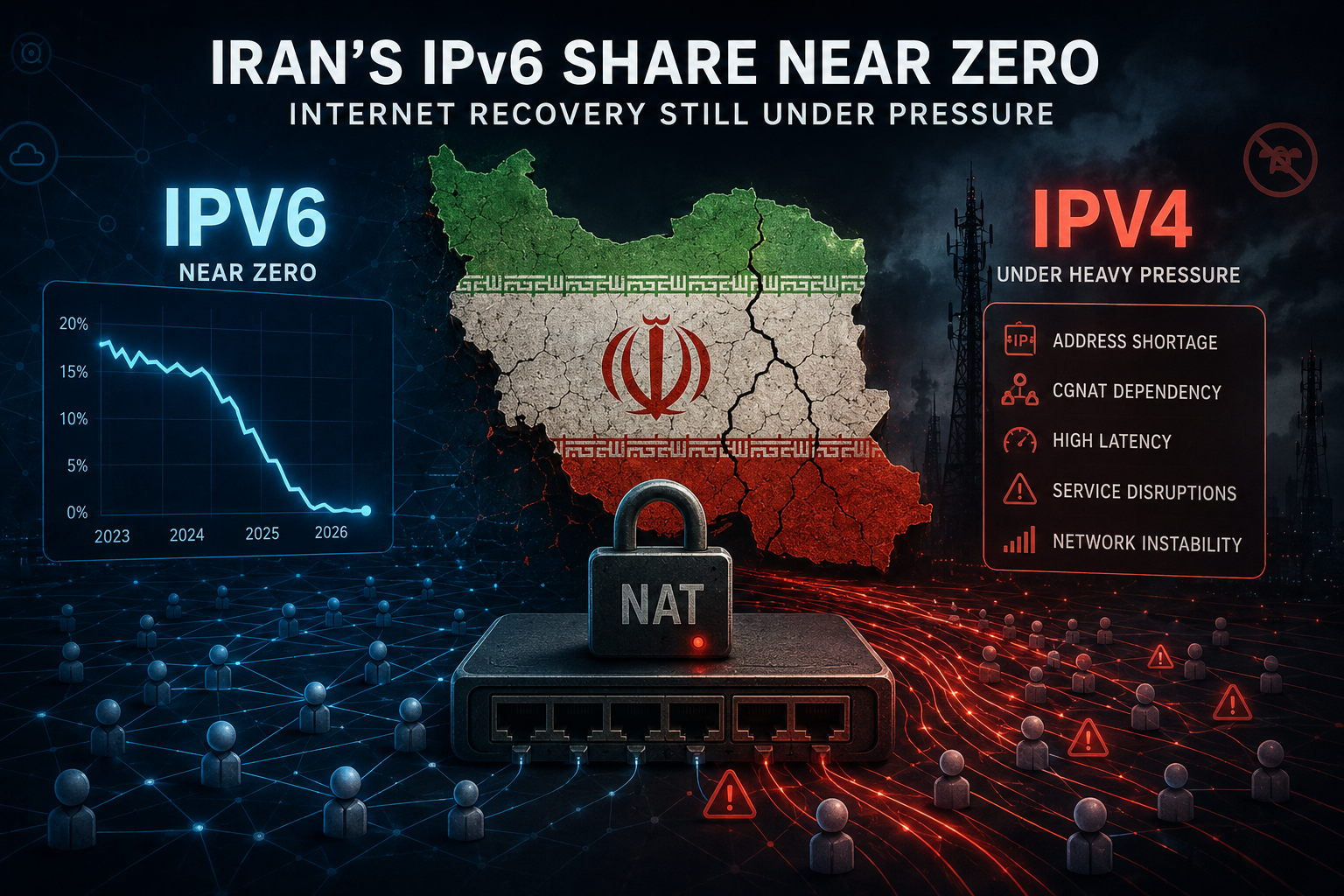

Iran’s IPv6 Share Remains Close to Zero
Recent network data indicates that the share of IPv6 traffic in Iran remains extremely low, with no meaningful sign of recovery in the country’s use of the newer internet protocol. This comes at a time when internet connectivity in Iran has partially returned after a prolonged period of shutdowns, restrictions and disruptions, but the network still appears to be facing technical instability, degraded performance and broad operational constraints.
The continued weakness of IPv6 matters because it suggests that a larger portion of user traffic is being pushed back onto IPv4 infrastructure. IPv4 has long been under pressure due to address scarcity, heavy reliance on NAT systems and the operational complexity of managing large-scale user traffic through older network architecture. As a result, the near-zero presence of IPv6 may increase the burden on the network and make full internet stabilization more difficult.
Why the Drop in IPv6 Matters
IPv6 is the newer generation of the internet protocol, designed to overcome the limitations of IPv4 by expanding address capacity, enabling more direct connectivity and reducing dependence on complex address translation layers. When IPv6 adoption falls sharply, more traffic is forced through IPv4, a path that is already heavily dependent on NAT and intermediary network systems in many countries, including Iran.
Under normal conditions, IPv6 can reduce pressure on IPv4 networks and offer a more scalable, direct and efficient route for users, operators and online services. But when IPv6 traffic falls close to zero, the network effectively shifts back toward an older and more congested model. This can affect connection quality, routing stability, service performance and the overall reliability of internet access.
A Full Return to IPv4 Means More Pressure on NAT
One of the most important consequences of reduced IPv6 traffic is increased pressure on Carrier-Grade NAT, or CGNAT. Because IPv4 addresses are limited, many users are often placed behind the same public IP address. While this helps operators manage address shortages, it can become a technical bottleneck when deployed at scale under heavy traffic conditions.
Greater dependence on NAT can lead to higher latency, more difficult troubleshooting and disruptions in services that require stable or direct connections. These may include online gaming, real-time voice and video calls, peer-to-peer services, VPN connections and some cloud-based tools. For this reason, network experts view the near-zero share of IPv6 not merely as a statistical detail, but as a sign of structural pressure inside the network.
IPv6 and Internet Stability After the Shutdown
After a partial return of internet connectivity, one of the most important technical challenges is restoring the network to a stable and reliable state. In this process, active IPv6 deployment can help ease part of the recovery by moving some traffic away from overloaded IPv4 routes and giving operators more flexibility in traffic management.
However, the continued weakness of IPv6 suggests that Iran’s internet infrastructure is not yet using all of its available technical capacity to return to normal conditions. This becomes especially significant when combined with reports of incomplete traffic recovery, heavy filtering, protocol-level disruptions and unstable access to online services. Cloudflare Radar has also reported a partial restoration of Iran’s internet after a months-long shutdown, while noting that the recovery remains limited and still developing.
Iran’s Previous Sharp Decline in IPv6 Adoption
The severe drop in IPv6 adoption in Iran is not entirely new. In 2024, Cloudflare Radar reported that a major portion of Iran’s IPv6 address space disappeared from the global routing table, causing the country’s IPv6 adoption rate to fall from roughly 15 to 20 percent to around 2 percent. The Internet Society also analyzed the event as a significant setback for Iran’s IPv6 development path.
During the 2026 internet shutdowns and restrictions, technical reports again pointed to the reduction or removal of IPv6 from parts of the network. Some analyses suggested that once IPv6 was removed, the remaining traffic was redirected toward IPv4, where filtering, inspection and traffic-control systems are more mature and more centralized. FilterWatch also noted that removing IPv6 could push remaining traffic back onto IPv4, a path that is easier for existing control infrastructure to manage.
Conflicting Data: Why Different Sources Show Different Numbers
When evaluating Iran’s IPv6 share, it is important to understand the difference between measurement sources. Some systems, such as APNIC, measure “IPv6 capability” based on whether users or tested networks are technically capable of using IPv6 over a specific period. These measurements may still show a figure above zero for Iran. By contrast, real-time traffic measurements or routing-based monitoring tools may show that the visible or active share of IPv6 traffic has sharply declined during disruption periods.
This means that the phrase “IPv6 is close to zero” must be interpreted carefully. It may refer to real traffic share, announced address space, user capability, routing visibility or adoption over a longer measurement window. Still, the broader picture remains clear: IPv6 in Iran’s internet infrastructure remains weak, unstable and far from playing the role it should in network recovery and long-term resilience.
Direct Impact on Users and Digital Businesses
For ordinary users, IPv6 may sound like a distant technical issue, but its impact can be visible in everyday internet use. When a network becomes too dependent on IPv4 and NAT, users may experience more problems with online games, video calls, cloud services, remote work tools, developer platforms and some VPN connections.
For digital businesses, the issue is even more serious. Data centers, cloud providers, e-commerce platforms, media services and application developers all rely on stable and predictable connectivity. In a network where IPv6 capacity is effectively inactive or severely limited, businesses face higher operational risk, more complex connectivity challenges and a weaker foundation for reliable online service delivery.
Conclusion: A Stable Internet Cannot Be Built on IPv4 Alone
The partial return of internet connectivity in Iran cannot be considered a full technical recovery if it is not accompanied by the restoration of key infrastructure layers such as IPv6. The near-zero share of IPv6 shows that the network remains heavily dependent on older IPv4 architecture and NAT systems, both of which can become serious weak points under conditions of pressure, restriction and high traffic demand.
If the goal is to restore a stable, efficient and reliable internet, then reviving IPv6 must be part of the country’s technical recovery plan. Otherwise, users may regain access to the internet on paper, while the underlying infrastructure remains under heavy pressure. That pressure can continue to appear in the form of slow connections, unstable services, degraded user experience and persistent network fragility.